Following her success exhibiting at Ceramic Art London in May, and her recent exhibition at the London Map Fair, we were pleased to join ceramicist Loraine Rutt In The Studio!
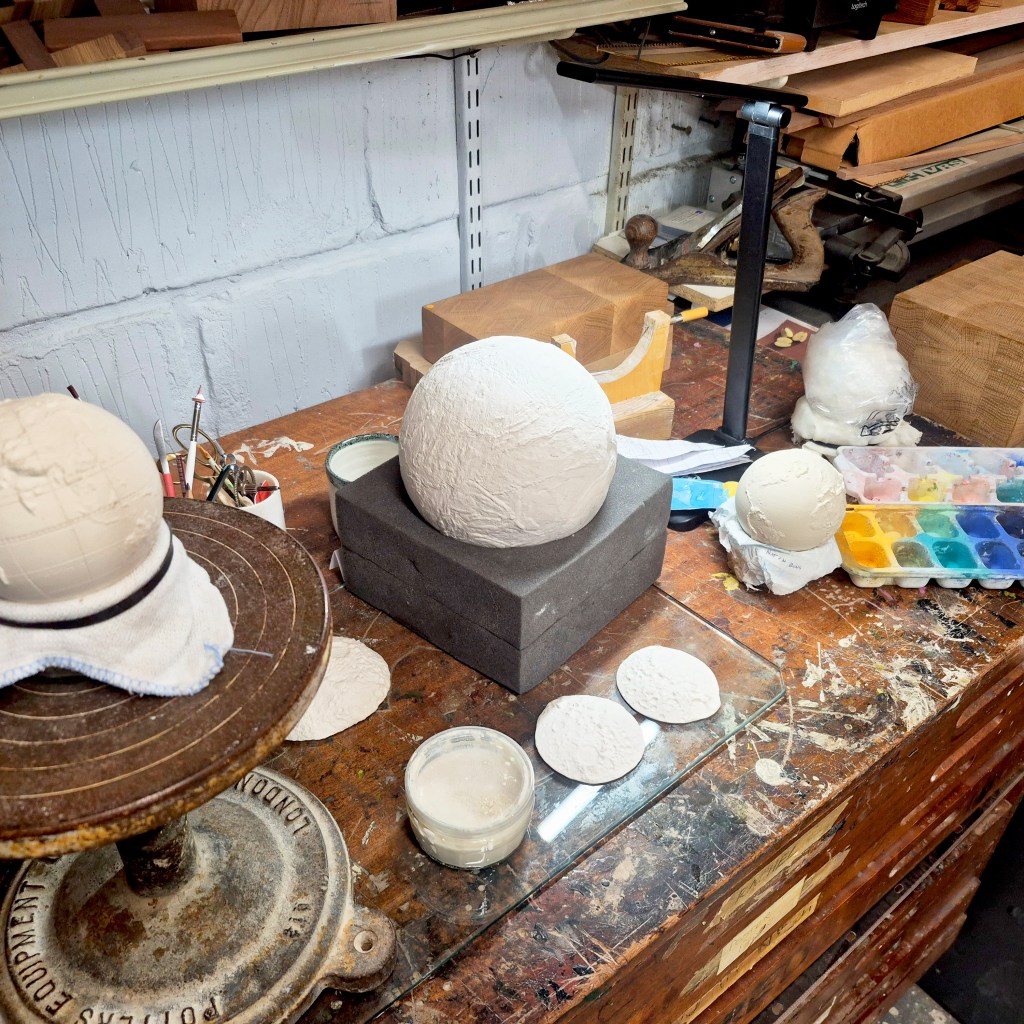
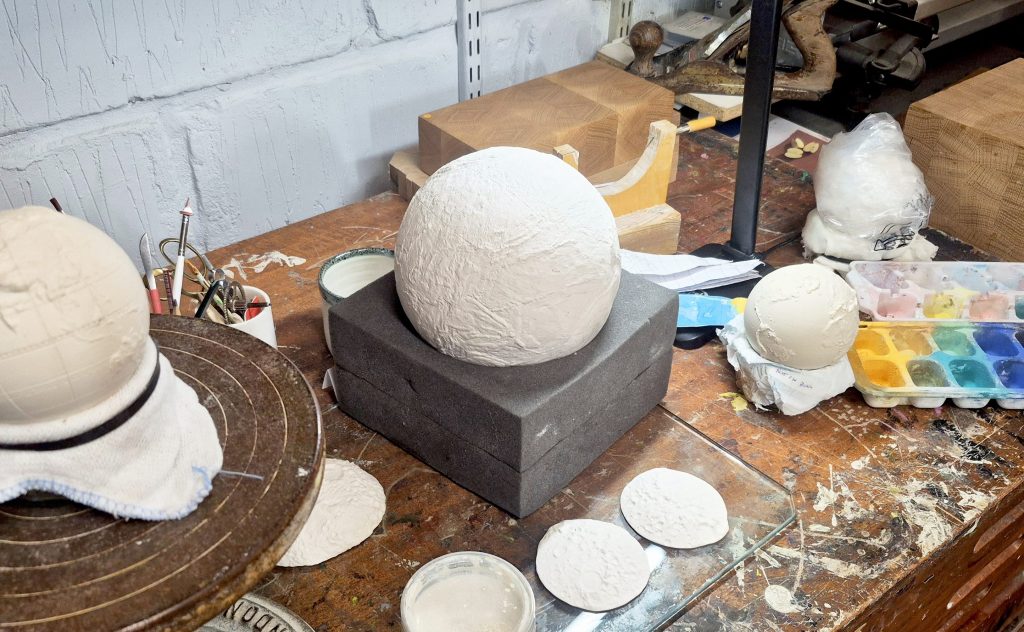
Showing us around her working space, the first thing Loraine shared was the process of forming her porcelain globes, from paper mapping to mould making, slip casting to fettling!
“To make these, I always start with a piece of paper, with a drawing” shared Loraine, “and I’ve used that to scribe into the clay. The first version of this is clay, but from that I make a rubber mould, from the rubber I make this kind of dense plaster version, and this goes off to the mould maker so I can then slip cast porcelain.”
Through her practice, Loraine has come to have a deep understanding of the contours of the earth and it’s seas, noting that “basically all of these lines, by the time it’s finished as ceramic, I’ve drawn them four times, because I’ve drawn them in paper, traced them onto the clay, scribed it into the clay, and then painted it (…) I’ve done quite a few now, so there’s a bit of muscle memory, of knowing where the mountain ranges are and where the river canyons are.”
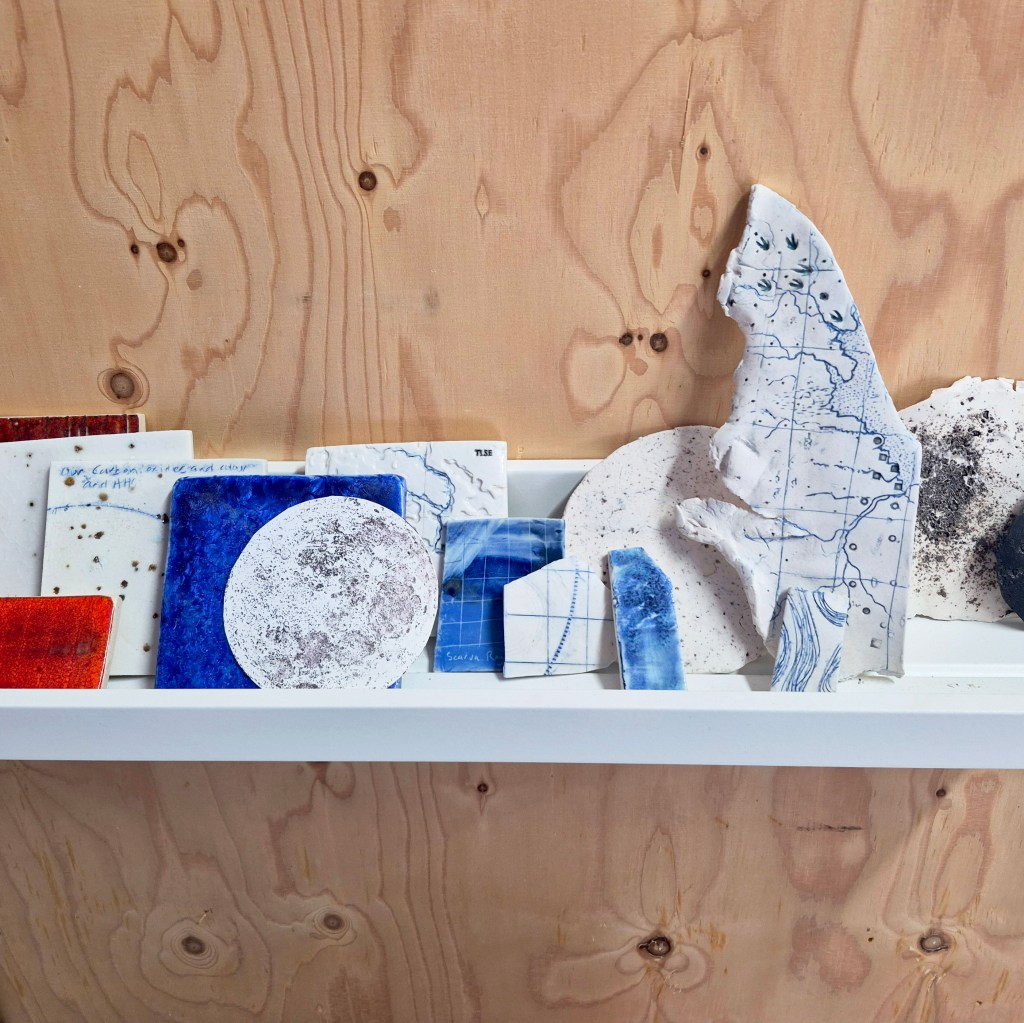
“All of the line work, all of the details, the coast lines, the longitude, latitude, on every single piece is drawn by hand” explained Loraine.
Showing us the tools used for fettling and detailing each piece, including a cog taken from a clock mechanism used to mark the equators – “a little nod to the passage of time, the rotation of the Earth, the movement of water down the river” – Loraine brought out the tool which had become infamous during London Craft Week, her grandmother’s Sheffield Steel needle. “I’ve made this ergonomic handle around it so I can hold it all day. So all of the detailing is scribed with this tiny pin.”
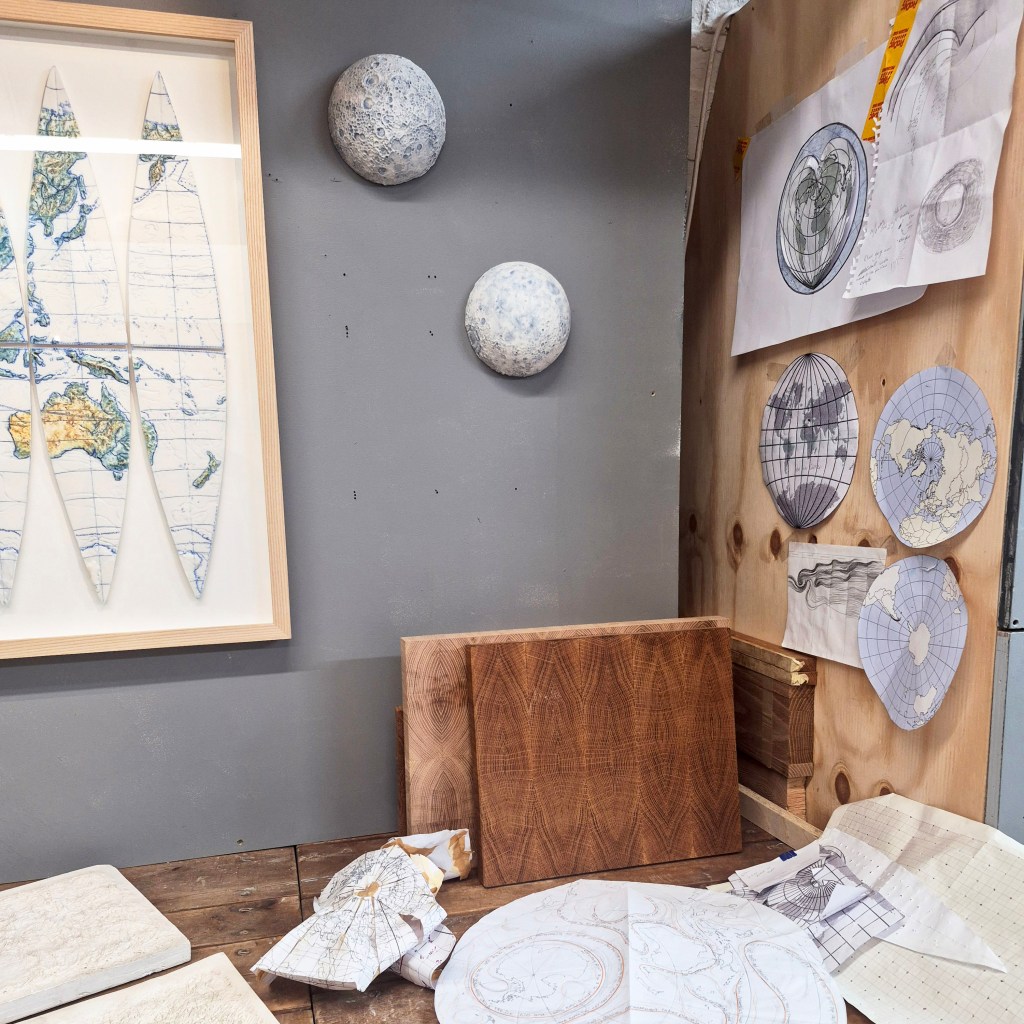
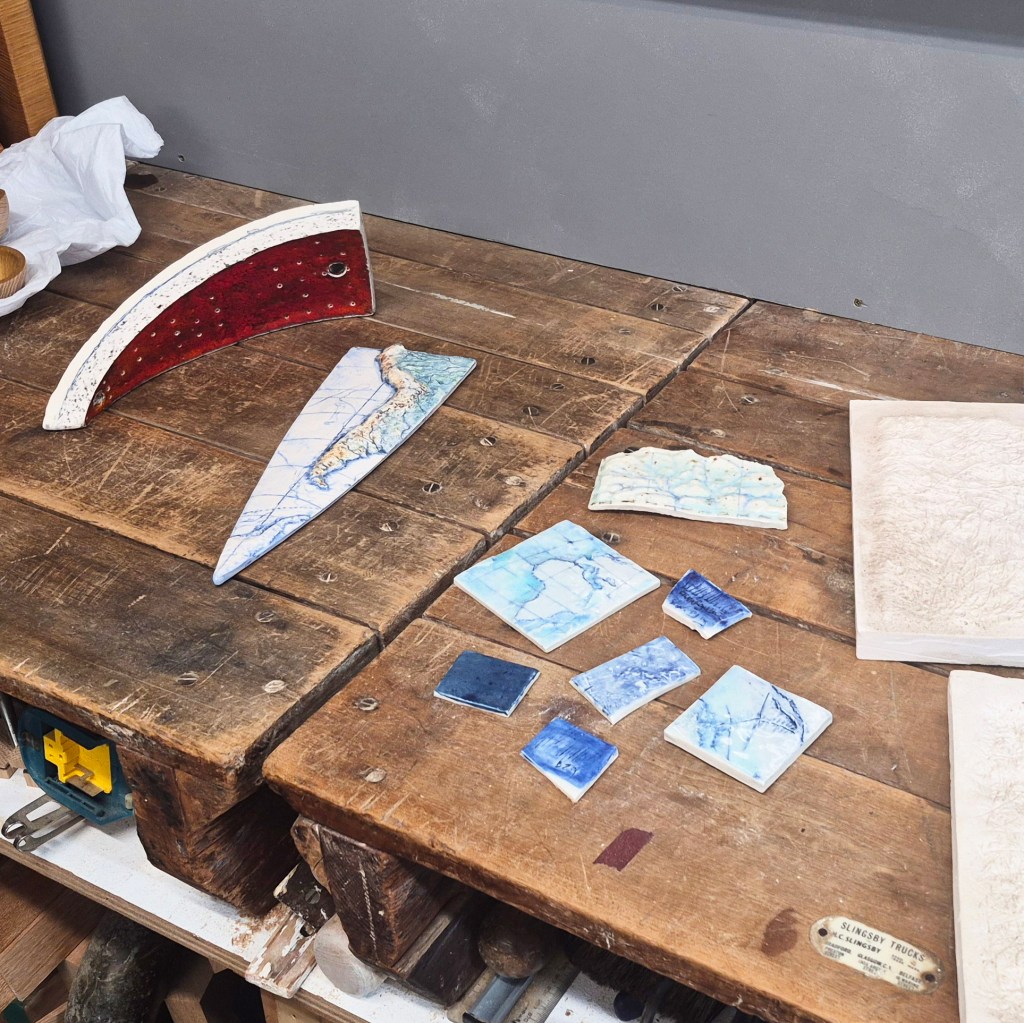
Loraine’s ‘Back Projections‘ series, which we exhibited at the London Art Fair at the beginning of the year, feature different map projections, reimagined and manipulated into different forms.
Beginning with paper templates, the outlines of each piece are traced onto the clay, and then the clay is folded back into the three dimensional form. Talking us through the process using her 2022 ‘Fuller’s Earth’ piece, Loraine explained, “I made a conventional globe, and then pinned out the triangulation points (…) so it’s all triangles which are then peeled back off the globe, and you get a map which shows all the world’s continents actually connected, rather than separated.”
Speaking on the Fuller’s projection which inspired the piece, Loraine shared that “it’s often used to illustrate ancient migration routes, because it shows how connected the continents are (…) I really like this map projection, because it shows just how connected we all are, rather than separate.” It is this idea of connectedness and common ground that underpins much of Loraine’s practice.
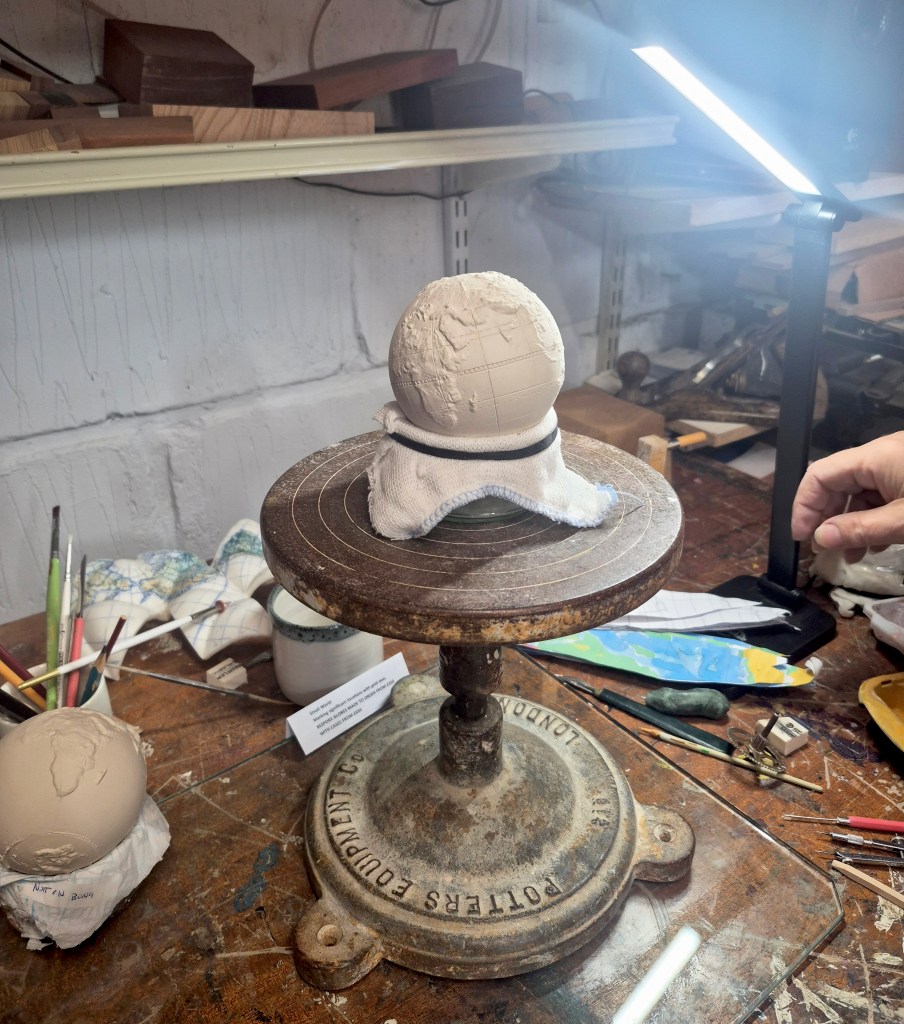
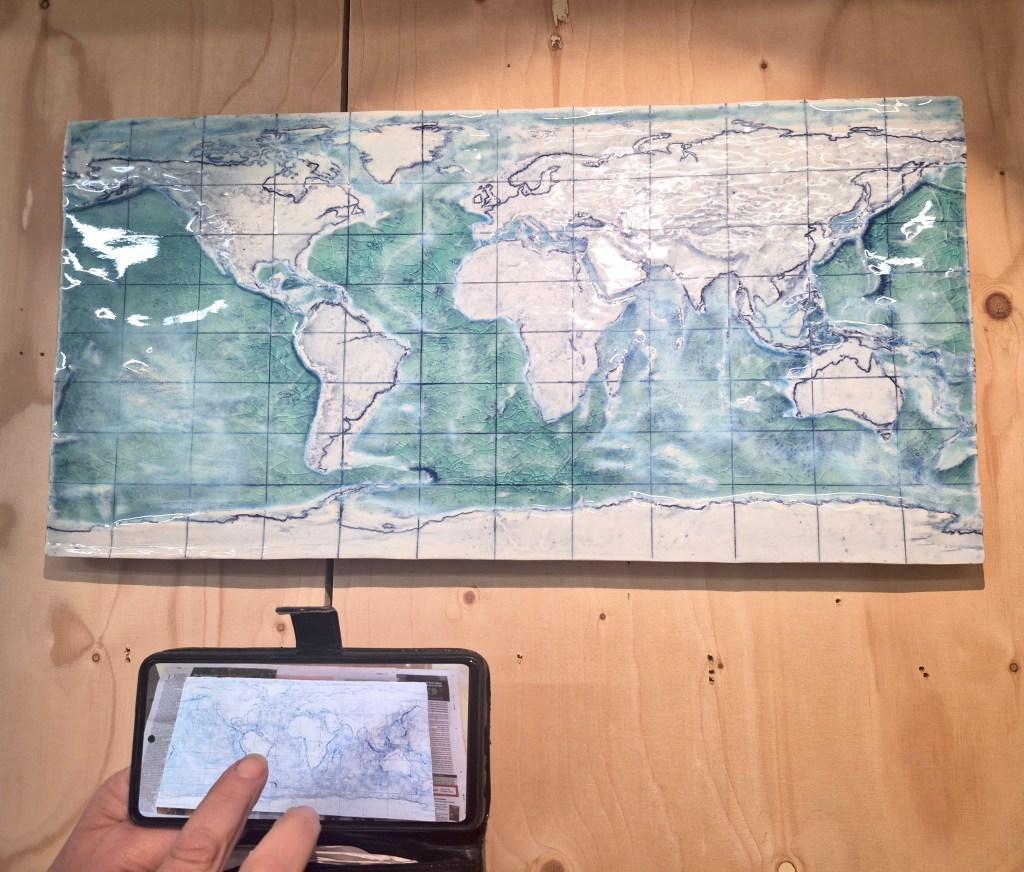
Next, Loraine demonstrated the various paints, oxides, and glazes she works with to finish each piece. In a few of her more recent works, Loraine has been experimenting with the ways to convey the fluidity of water on the surface of the clay.
“I love what you can do with glaze to symbolise water. That’s something the 16th and 17th C. mapmakers were really good at with those little engraved lines, you really get a sense of the movement of the oceans.”
A lot of Loraine’s inspirations come from artisans of the 16th and 17th Centuries. In particular, Loraine has a love of the 16th C. Italian Majolica artists, who painted onto unfired glaze.
“It literally is like painting onto blotting paper, you cannot make a mistake”, she explained with awe,”baring in mind, they didn’t have the coloured stains that we’ve got now, where some of the colours are quite true, they were working with things like Cobalt Carbonate [a pale pink that fires to an intense blue] (…) They’re painting cherubs and woodland scenes, allegorical Ancient Greek and biblical scenes, and they are doing it effectively without being able to see the actual colour. Blows my mind.”
The work Loraine is currently developing involves layering glazes thickly to explore portrayals of the ocean floor, and the expanse and movements of our seas.
“Some magic that happens in the kiln, which I love, is just the combination of two glazes, and the thickness and firing temperature, resulting in this beautiful variation in depth and tone underneath the surface.”
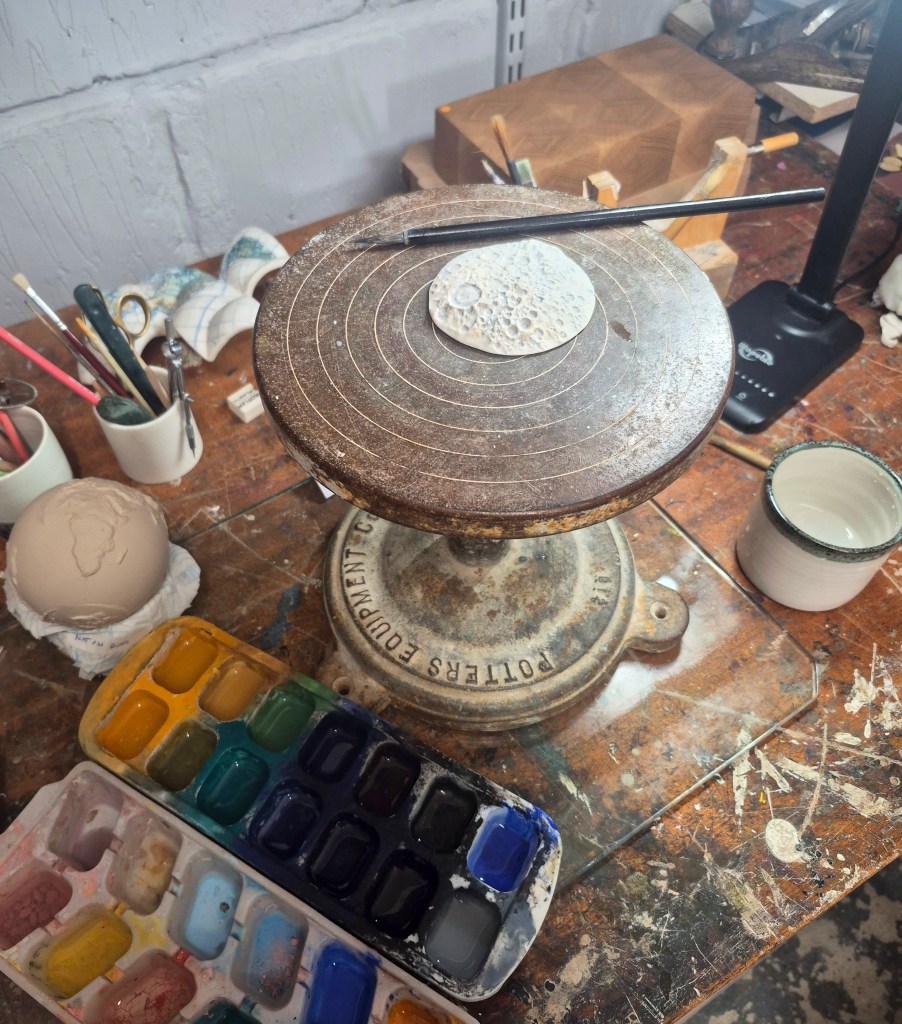
Two small paint palettes sat beside Loraine’s work station, filled with an assortment of different brightly coloured pigments. Slowly and precisely, Loraine poured water over the coloured powders, filling each of the small pots.
“Some of these are ceramic oxides (…) and these are ceramic stains. I filled this palette up with these colours in these locations probably about 30 years ago, and I just keeping topping it up.”
As Loraine began dotting the colours onto her porcelain piece, she continued, ” In my head I’ve got this memory map of what these colours do when they’re fired, so when I’m painting it becomes quicker. This set here are like a muted watercolour washes that you get on antique maps, but the colours change a lot when they’re fired.”
While appearing just as regular paints once mixed, Loraine explained that, actually,”all of the colours, whether they’re stains or oxides, are heavy, so they settle out in water and you have to keep remixing them.”
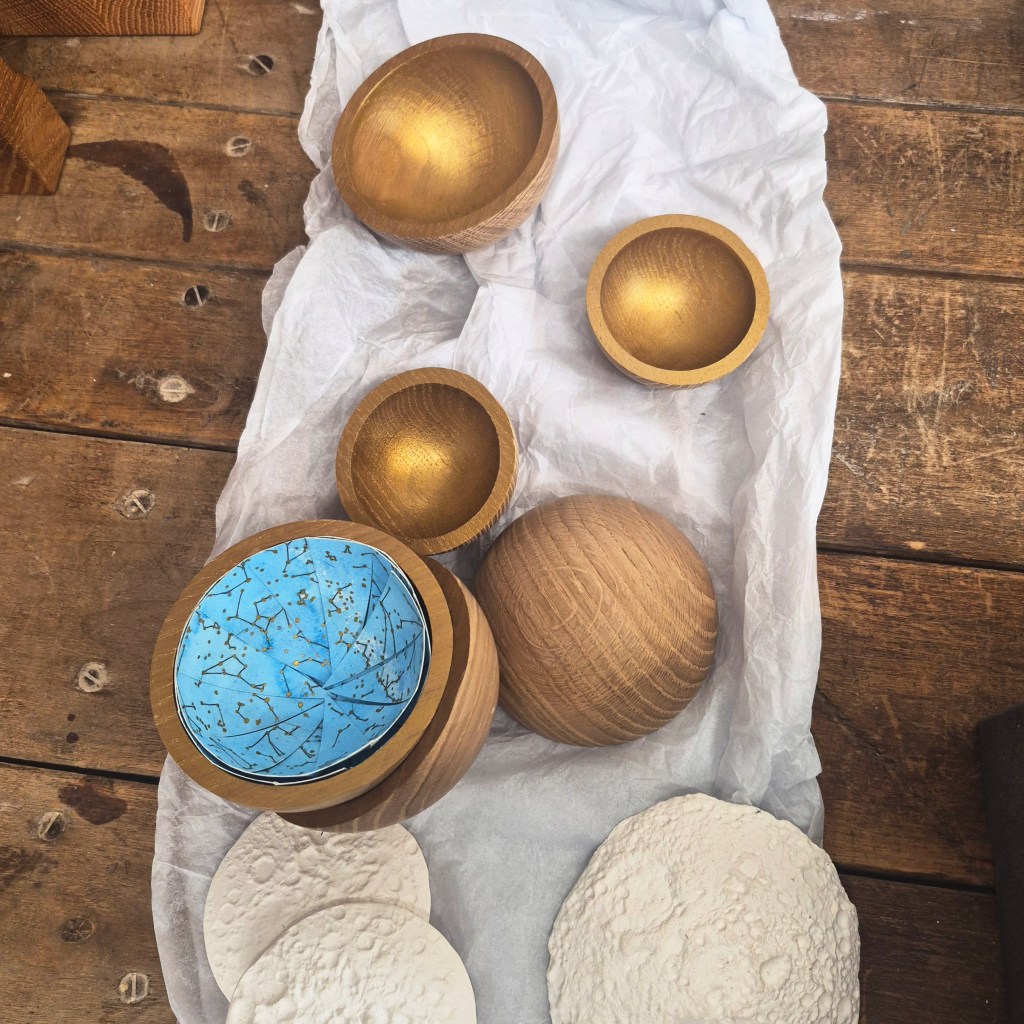
Though many mistake the interiors of Loraine’s pocket cases for enamel, they are in fact paper! The paper is drawn and painted, then cut to size and moulded to fit the case.
“I use traditional globe-making techniques, so it’s archive quality starch paste to glue them in, and then I’m using traditional shellac lacquer, so it’s like a lacquering and French polishing technique. A lot of people think that they’re enamel, and that they’re glazed, but it’s not. It’s the same as making a paper globe, but instead I’ve inverted it and put it on the interior instead of the exterior.”
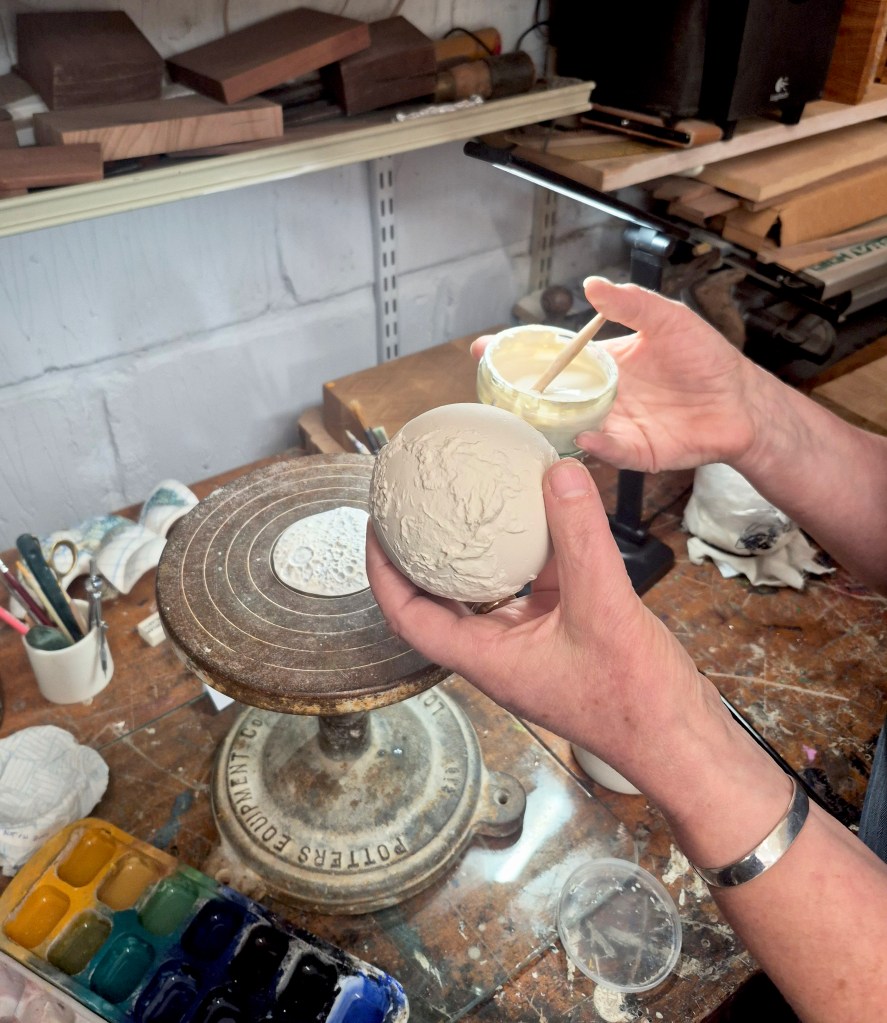
After the moulds are made, Loraine casts each hollow globe with porcelain slip, which she showed us a small sample of here!
“The great thing about casting slip is it’s thixotropic, so the more you stir it, the more fluid it becomes (…) it’s basically really fine clay particles suspended in water, and the process of casting is that the plaster mould is absorbent, and absorbs the water, and so you get a crust of clay forming on the inside of the mould.”
Due to their hollowness, and porcelain material, each globe is incredibly fragile, explained Loraine. “The clay will break very easily. They’re slightly stronger than eggshell, and they’re hollow. Porcelain doesn’t like being solid, it will just crack. The bits exposed to the air will shrink, and the middle won’t, so it will just splinter. (…) It’s quite satisfying. People often ask what the clay feels like at this stage, and it reminds me of chocolate Easter eggs, it feels very similar to tempered chocolate.”
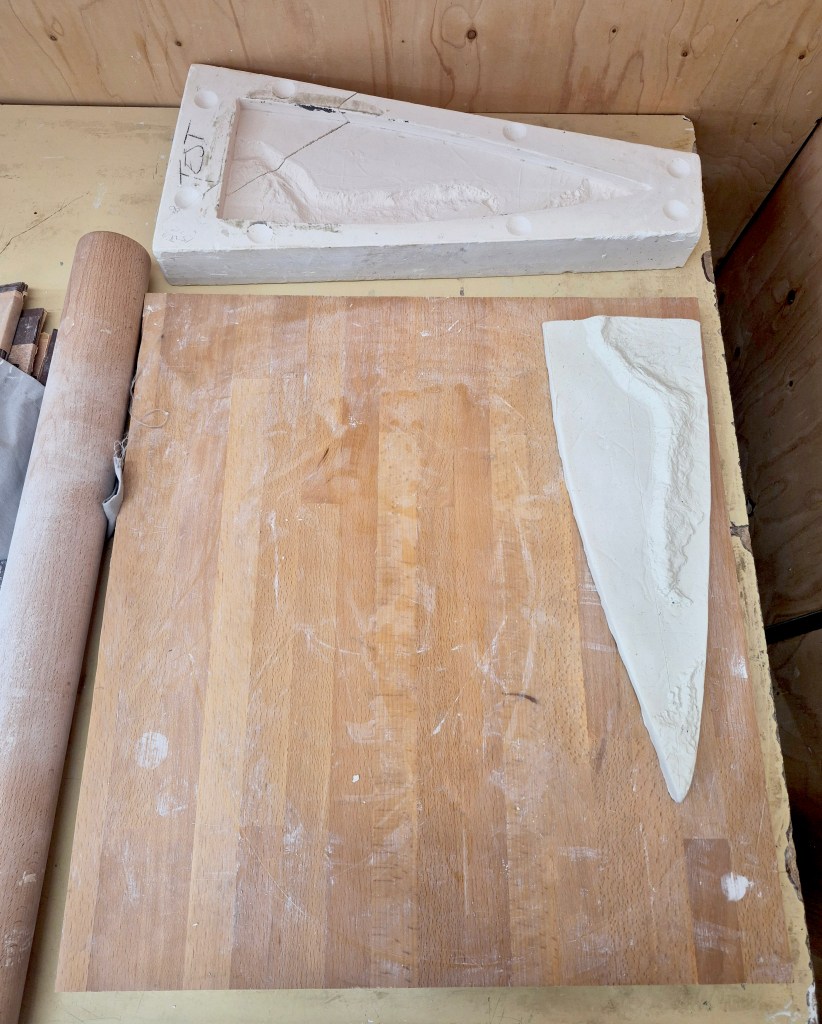
Working with techniques of both slip casting and press moulding, means Loraine can create editions of each piece which, unlike with printing where the editions are made at the same time, each edition here is created from scratch using the mould.
“If you look on the back of my works, you can always see what I’ve press moulded and what I’ve slip cast” joked Loraine, “because if I’ve press moulded it there will still be that thumbprint on the back of it.”
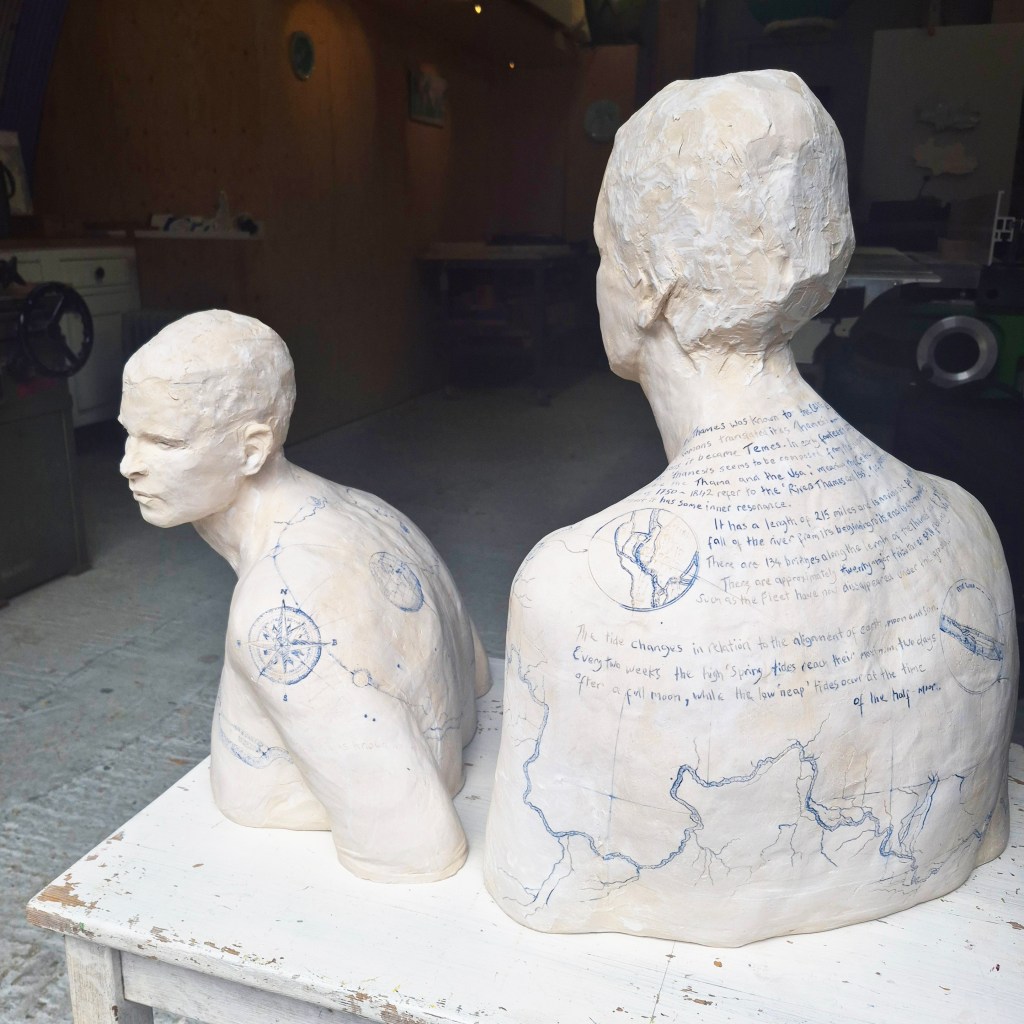
Throughout the studio visit, we got the sense that this is a process that can be very peaceful and relaxing, despite a regular heavy workload of deadlines to meet and commissions to complete.
“It’s not that time stops, but I can look up and it will be dark outside, it’s very absorbing, you have to just commit to it completely. When I’m developing new work, the bit that I love is playing with the material and finding what it can do, just watching what’s happening in front of you and just being responsive to that.(…) I like experimenting and seeing what comes out of the kiln, and then that might spark an idea. But more often than not, the idea comes first, and then I experiment to find ways of achieving it.”

